

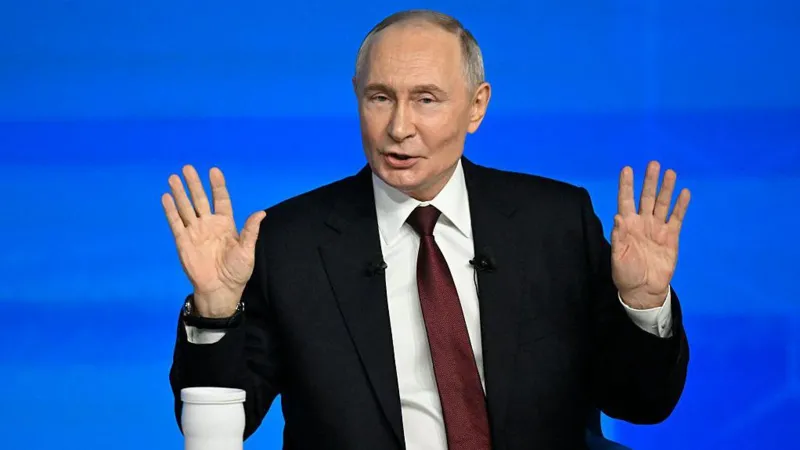
Russian President Vladimir Putin has said Moscow has no interest in starting new wars after the conflict in Ukraine, insisting that peace is possible if Western countries treat Russia as an equal and respect its security interests.
Speaking during a lengthy live televised question-and-answer session that lasted more than four hours, Putin dismissed claims that Russia plans to attack European nations, calling such warnings baseless and exaggerated. He said Russia would not launch any further military operations if it is dealt with fairly by Western powers.
Putin was responding to a question from a Western journalist who asked whether Russia might carry out more so-called “special military operations,” the term the Kremlin uses to describe its war in Ukraine. The Russian leader said there would be no reason for future conflicts if Russia’s concerns are taken seriously.
According to him, Russia only wants its interests respected in the same way it claims to have respected those of the West for decades. He added that tensions grew because Western countries, in his view, failed to honour earlier understandings, especially over the expansion of NATO closer to Russia’s borders.
Putin again accused NATO of moving eastward despite what he described as earlier assurances given to Soviet leaders around 1990. Western governments have repeatedly rejected this claim, but Putin said the issue remains at the heart of Russia’s mistrust of the West.
The live broadcast, known as the “Direct Line,” combined questions from ordinary Russians and journalists across the country. Putin spoke from a large hall in Moscow, seated beneath a massive map of Russia that also showed territories in Ukraine currently under Russian control, including Crimea.
Russian state media said millions of questions were sent in by the public. While many were supportive or neutral, some critical comments were also displayed, including complaints about rising prices, internet disruptions, and poor public services.
During the event, Putin addressed domestic economic challenges, acknowledging that Russians are feeling the pressure of rising living costs. Inflation, higher taxes, and slowing growth featured prominently in public questions. As he spoke, Russia’s central bank announced a cut in interest rates, a move the Kremlin presented as a sign of economic stability.
Despite the wide range of topics, the war in Ukraine remained a constant backdrop. Putin repeated his claim that Russia is open to ending the conflict through negotiations, but he did not soften his core demands. He insisted that Ukrainian forces must withdraw from several regions partly controlled by Russia and that Ukraine must abandon its ambition to join NATO.
He also claimed that Russian troops are making progress on the battlefield and mocked Ukrainian President Volodymyr Zelensky’s recent visit to frontline areas, where Kyiv denied Russian claims of territorial gains.
On peace efforts led by the United States, Putin said he appreciated what he called sincere attempts by former US President Donald Trump to bring the war to an end. However, he argued that Western governments and Ukraine’s leadership are the main obstacles to a deal.
Putin said Russia would be ready to stop fighting immediately if long-term security guarantees are put in place. He stressed that Moscow wants to work with Europe, the United Kingdom, and the United States, but only on the basis of equality and mutual respect.
Western intelligence agencies have warned that Russia could pose a broader military threat to NATO in the coming years. NATO leaders have urged member states to prepare for possible future confrontations. Putin rejected these warnings, accusing Western countries of deliberately portraying Russia as an enemy.
As the broadcast drew to a close, Putin answered lighter questions about personal beliefs, love, and values. He surprised viewers by saying he believes in love at first sight and hinted that he is currently in love, without giving further details.
While the Kremlin presented the event as proof of openness and strength, Putin’s remarks showed little sign of compromise on Ukraine, reinforcing the view that any path to peace will remain difficult and deeply contested.